
Introduction
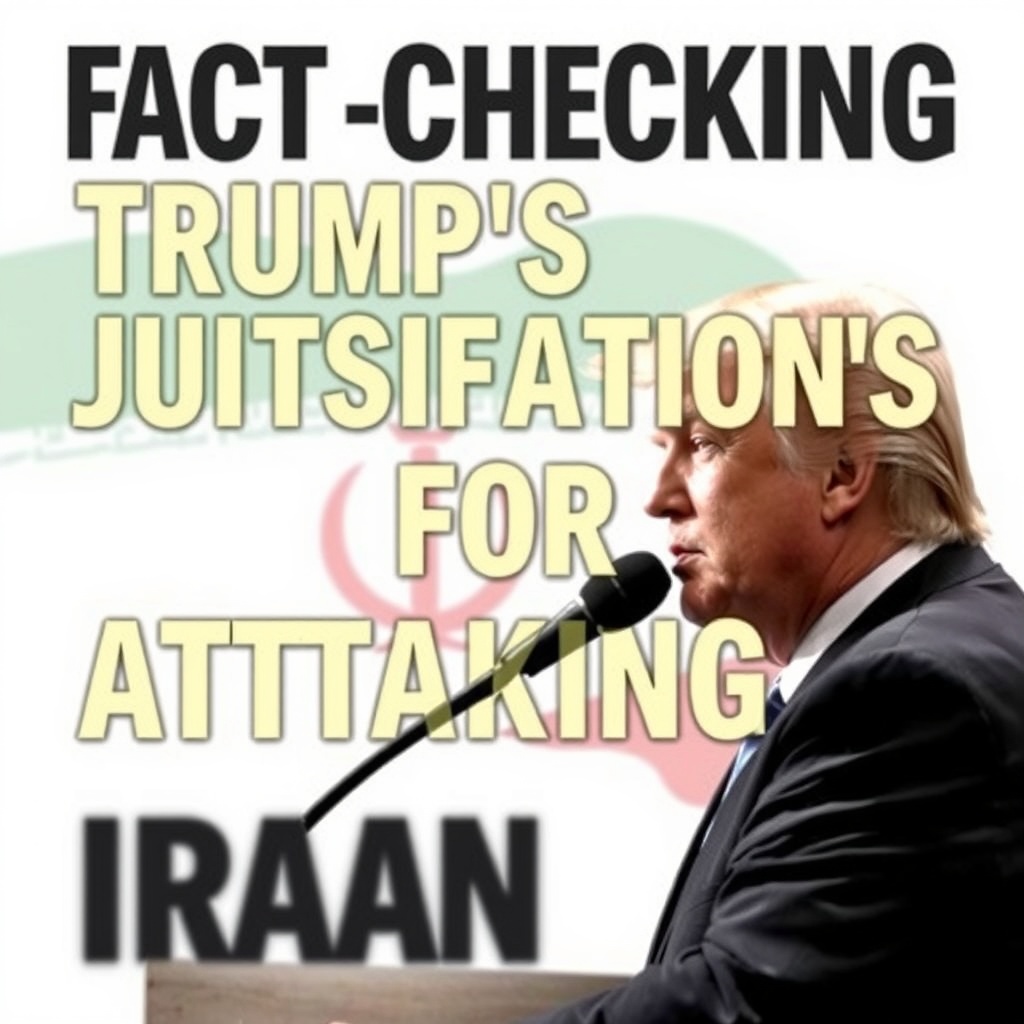
On February 28, 2026, President Trump addressed the nation, announcing a military attack on Iran. In his speech, the president provided several justifications for the attack, citing various reasons and claims. However, a closer examination of these justifications reveals a mixture of unsupported and exaggerated claims. This article aims to fact-check the president's statements, providing an in-depth analysis of the evidence and data behind his assertions. By examining the facts and figures, we can better understand the motivations and implications of the attack on Iran.
Background and Context
To understand the president's justifications, it is essential to consider the historical context and background of the US-Iran relationship. The two countries have had a complex and often contentious relationship, with periods of heightened tensions and conflict. The US has imposed economic sanctions on Iran, and the country has been accused of supporting terrorism and developing nuclear weapons. In recent years, the US has increased its military presence in the region, with a focus on countering Iranian influence.
According to a report by the Congressional Research Service, the US has spent over $1.5 trillion on military operations in the Middle East since 2001, with a significant portion of these funds allocated to countering Iranian activities. The report also notes that the US has imposed over 1,000 sanctions on Iranian individuals and entities, including companies and government officials.
Fact-Checking the President's Claims
In his speech, the president made several claims about Iran's activities and the reasons for the attack. One of the primary justifications cited by the president was Iran's alleged support for terrorism. The president claimed that Iran was responsible for numerous terrorist attacks around the world, including the 2019 attack on Saudi Arabian oil facilities.
However, a fact-check by the Washington Post found that while Iran has been accused of supporting various militant groups, there is limited evidence to support the claim that Iran was directly responsible for the 2019 attack on Saudi Arabia. The fact-check also noted that the president's claim that Iran was responsible for "thousands" of terrorist attacks was exaggerated, with most estimates suggesting that the number of attacks attributed to Iran is significantly lower.
Another justification cited by the president was Iran's nuclear program. The president claimed that Iran was developing nuclear weapons, and that the attack was necessary to prevent the country from obtaining a nuclear bomb. However, a report by the International Atomic Energy Agency (IAEA) found that Iran's nuclear program was subject to strict monitoring and inspections, and that there was no evidence to suggest that the country was developing nuclear weapons.
The IAEA report also noted that Iran had complied with the terms of the 2015 nuclear agreement, known as the Joint Comprehensive Plan of Action (JCPOA). The report stated that Iran had reduced its uranium enrichment activities, and that the country's nuclear program was subject to regular inspections and monitoring.
Economic and Diplomatic Implications
The attack on Iran has significant economic and diplomatic implications, both for the US and the international community. The president's decision to launch a military attack on Iran has been met with widespread criticism, with many countries expressing concerns about the potential consequences of the attack.
According to a report by the Brookings Institution, the attack on Iran could have significant economic implications, including a potential increase in oil prices and a disruption to global trade. The report also noted that the attack could have diplomatic implications, including a potential deterioration in relations between the US and its allies.
A survey of international leaders conducted by the Pew Research Center found that a majority of countries opposed the US attack on Iran, with many expressing concerns about the potential consequences of the attack. The survey also found that the attack had damaged the US's reputation as a global leader, with many countries viewing the US as a unilateral actor that is willing to disregard international norms and institutions.
Case Studies and Examples
To better understand the implications of the attack on Iran, it is useful to consider case studies and examples from similar situations. One relevant example is the 2003 US invasion of Iraq, which was justified on the grounds that Iraq possessed weapons of mass destruction. The invasion was widely criticized, and it ultimately led to a prolonged and bloody conflict that had significant humanitarian and economic consequences.
Another relevant example is the 2011 US intervention in Libya, which was justified on the grounds that the Libyan government was committing human rights abuses. The intervention ultimately led to the overthrow of the Libyan government, but it also created a power vacuum that was exploited by militant groups.
In both cases, the US interventions were justified on the grounds that they were necessary to prevent humanitarian crises or to counter threats to national security. However, the interventions ultimately had significant unintended consequences, including the creation of power vacuums and the exacerbation of humanitarian crises.
Conclusion
In conclusion, the president's justifications for attacking Iran are based on a mixture of unsupported and exaggerated claims. While Iran has been accused of supporting terrorism and developing nuclear weapons, there is limited evidence to support these claims. The attack on Iran has significant economic and diplomatic implications, and it has the potential to create a power vacuum that could be exploited by militant groups.
As the international community moves forward, it is essential to consider the facts and evidence behind the president's claims. By examining the data and research, we can better understand the motivations and implications of the attack on Iran, and we can work towards creating a more peaceful and stable world. Ultimately, the attack on Iran is a reminder of the importance of fact-checking and critical thinking, and the need for leaders to be held accountable for their actions and claims.

Leave a comment